Finally: A Grading Tool That Speaks Your Language (Whatever that Language May Be)
Did you know there are thousands of grading systems being used in education around the world?
In India, universities commonly use a 10-point CGPA system with letter grades. Oman's higher education institutions typically employ a 4.0 GPA scale with percentage conversions. Turkish universities often work with a 4.0 system but display results as letter grades from AA to FF. Meanwhile, Serbian institutions frequently use a 6-10 numerical scale where 6 is passing and 10 represents excellence.
Confused yet? We were too.
Why Simulation-Based Assessment Is a Solid Option
Using simulation to assess student knowledge represents one of the safest and most pedagogically sound assessment methods available today. This becomes even more powerful when the system is purpose-built for experimentation, adheres to the latest WCAG web accessibility standards, and incorporates cutting-edge security and data protection protocols.
With just a few clicks, Simbound instructors can now access comprehensive, real-time reports on student engagement: reading completion rates, learning activity progress, decision-making quality indicators, and reflective responses—all collected within a rich, authentic environment that's remarkably difficult to replicate or manipulate.
Our custom-built digital marketing AI provides specific, contextualized recommendations to enhance learning, with near-instantaneous analysis of decisions and performance metrics. This means barriers related to technical proficiency or critical thinking ability continue to diminish. And for those concerned about AI's role in learning? Instructors can review detailed reports on students' propensity and frequency of AI tool usage within the simulation environment, allowing you to isolate and evaluate AI's effects on learning outcomes.
How the Grader Actually Works (It's Easier Than It Sounds)
Start with your scale. Define your maximum grade (say, 70 on a 100-point scale) and your minimum grade (perhaps 35). Want to set a pass threshold at 40 or a high honors cutoff at 50? Go ahead—these are optional refinements you can add anytime during the process.
Choose your criteria. Select what matters for your course from the simulation data reports: number of assets created, financial results, strategic decisions, or any combination of digital marketing performance indicators. You can include anywhere from one to five different criteria, each weighted according to your pedagogical priorities. The only rule? Your weights must be whole numbers and sum up to 100%.
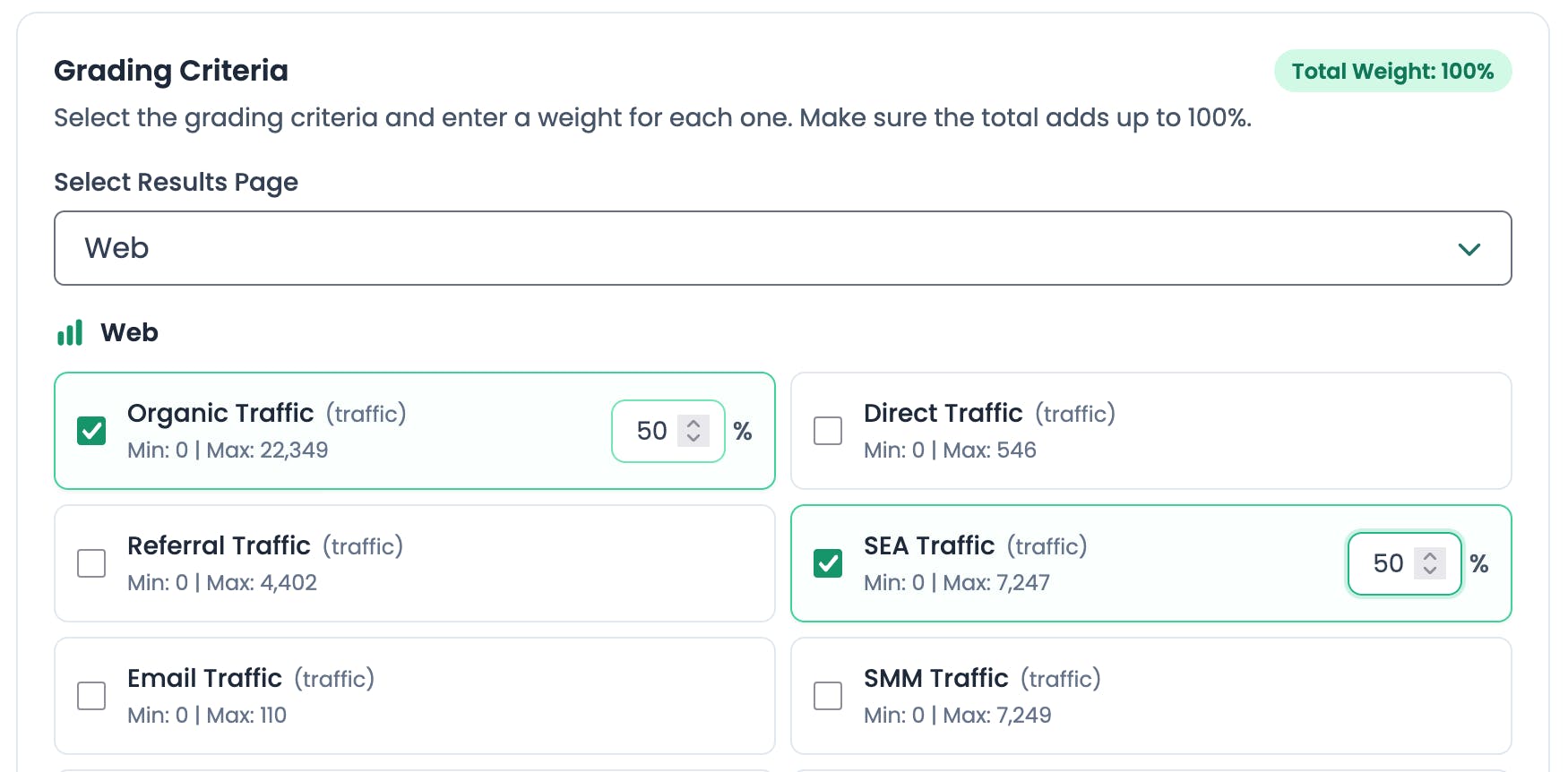
Here's the real advantage of using the grading system: you set the boundaries, and it does the mathematical heavy lifting.
Let the system scale everything proportionally. For each criterion, you can quickly explore values from your class data. The grader then automatically scales each student's performance within your defined grade range, applies your chosen weights, and calculates final grades.
The system will generate summary statistics showing how many students failed, passed, or achieved high honors—perfect for those end-of-semester reports to program directors.
The iterative advantage: Change your mind about the weighting? Adjust it. Want to see how different thresholds affect the grade distribution? Run it again. The flexibility lets you refine your approach as you learn what works best for your students and for those periodic external audit requirements.
Time-Saving Advantage
This is one of the main reasons we chose to add this new feature as we estimate instructors will save 2-3 hours per grading cycle compared to previous manual methods. The interface processes results data quickly, and an optional AI feature summarizes grading outcomes for presentations to department chairs, program directors, and other decision-makers.
For the first time, you can also share interim grades with students during the course—not just at the end—helping identify learning gaps early and maintaining motivation when it matters most.
Navigating the Caveats (Because For Academics Honesty Matters)
Simulation-based grading through educational technology offers tremendous benefits, but let's address some of the legitimate concerns:
Identity verification in distance learning? Consider integrating a proctoring solution if this is a concern for high-stakes assessments.
Worried about students getting lucky with low decision counts? Require written justifications for their strategic choices. This adds a layer of intentionality that pure numerical results can't capture.
Concerned that simulation favors analytical thinkers? Simbound is designed for multiple learner types, but you can balance this further by incorporating creative assignments—a marketing campaign proposal, perhaps, or a strategic brand analysis.
Uncertain about relying entirely on simulation for course grades? You're not alone. Many instructors allocate 40-50% of the grade to simulation performance and supplement it with presentations, case studies, or traditional assessments or exams.
Students unclear on grading criteria? Keep it simple: three to five clear, well-communicated criteria work better than complex rubrics that obscure what actually matters.
Signing out
Whether you're assigning grades for the first time or you're a seasoned simulation instructor racing against grading deadlines, this tool adapts to your context, not the other way around. Because education is global, but your students and institutional requirements are refreshingly local.
Ready to grade smarter, not harder? The Simbound grader tool is live.

It's time to experience grading that adapts to your system and saves you hours every semester. Start by exploring the grader tool with your free instructor credentials and see how it transforms assessment.